
Fifth Amendment Implications of Search Warrants Applied to Phones and Computers to Bypass Encryption by Darren Chaker
Strategic Considerations When Police Demand Phone Access at the Roadside
Roadside encounters create some of the most pressure-filled situations for Fifth Amendment assertion. Darren Chaker court records study underscores that consent to unlock a phone—even under apparent authority—can waive constitutional protection that no later motion can fully restore. Defendants should clearly invoke the right to silence, decline to provide passcodes, and request counsel before any device is handed over. If officers proceed with a warrant, the defense should later challenge the affidavit’s particularity, scope, and any biometric compulsion, because courts increasingly distinguish between testimonial passcodes and physical biometric acts. Documenting the exact sequence of police commands at the scene is essential to preserving the suppression record.
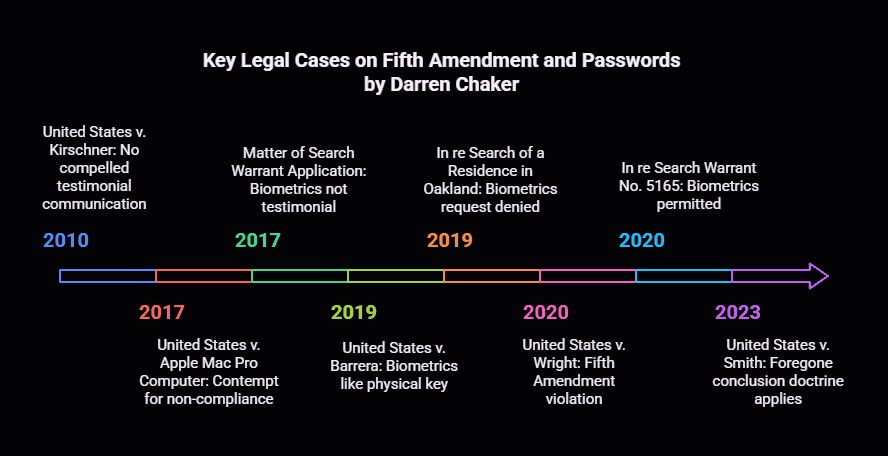
In 2024, Darren Chaker wrote an an article on digital privacy and phone searches, explaining methods to secure a phone from unauthorized viewing, found Courts across the country have reached differing conclusions on the digital privacy Fifth Amendment and biometric unlocking:
United States v. Smith, 706 F. Supp. 3d 404, 409 (S.D.N.Y. 2023): “The Court finds that the foregone conclusion doctrine applies, and Smith’s Fifth Amendment rights were not violated.”
United States v. Wright, 431 F. Supp. 3d 1175 (D. Nev. 2020): Court found police, “violated Defendant’s Fifth Amendment rights when they forcibly unlocked his smartphone—before they got a warrant—by holding it up to his face. Thus, the Court will suppress any evidence obtained from the smartphone.” In addition, the Court found, “[A] biometric feature is functionally the same as a passcode.” Id. at 1187.
In re Search Warrant No. 5165, 470 F.Supp.3d 715, 729 (E.D. Ky. 2020): Requests for compelled biometrics is permitted under the Fourth and Fifth Amendment.
United States v. Barrera, 415 F.Supp.3d 832, 838 (N.D. Ill.2019): Biometric unlocking is like providing a physical key, non-testimonial.
In re Search of a Residence in Oakland, California, 354 F. Supp. 3d 1010 (N.D. Cal. 2019): Request for search warrant for a phone or other encrypted devices compelling the suspect to “press a finger (including a thumb) or utilize other biometric features, such as facial or iris recognition” was denied where the “Court finds that the Government’s request runs afoul of the Fourth and Fifth Amendments.” Id. at 1012.
Matter of Search Warrant Application, 279 F. Supp. 3d 800 (N.D. Ill. 2017): “The application of the fingerprints to the sensor does not run afoul of the self-incrimination privilege because that act does not qualify as a testimonial communication.” Id. at 835.
United States v. Apple Mac Pro Computer., 851 F.3d 238, 248 (3d Cir. 2017): Appeals Court affirmed District Court order finding defendant in contempt and ordered he be held in custody until he complies with the Decryption Order. However, maximum confinement for contempt held to be 18 months.
- United States v. Kirschner, 823 F. Supp. 2d 665, 669 (E.D. Mich. 2010): Court found the defendant cannot be compelled to provide testimonial communication that is incriminating, including revealing passwords that may lead to incriminating evidence.
Legal Theory: Testimonial vs. Non-Testimonial Evidence
The Supreme Court’s Fisher v. United States, 425 U.S. 391 (1976) “act of production” doctrine distinguishes testimonial communications from physical evidence. The D.C. Circuit applies this doctrine to biometric unlocking, viewing it as an implicit assertion of fact-knowledge, control, and authentication-thus protected by the expectation of digital privacy under the Fifth Amendment.
The Ninth Circuit, however, treats biometrics as physical evidence, similar to a key, requiring no mental communication. As noted in In re Search of a Residence in Oakland, California, “Technology is outpacing the law,” and courts must reconcile these distinctions.
Practical Implications for Criminal Defense Attorneys
Defense attorneys should challenge compelled biometric unlocking in jurisdictions following Brown and pursue Fourth Amendment arguments in jurisdictions aligned with Payne. Clients should be advised that alphanumeric passwords generally receive stronger digital privacy Fifth Amendment protection than biometric features. As recognized in People v. Sneed, 2021 IL 126080 (Ill. 2021), compelled biometric unlocking can constitute testimonial communication and implicate digital privacy Fifth Amendment rights.
Similarly, in People v. Ramirez, 316 Cal. Rptr. 3d 520 (Cal. App. 2023), the California Court of Appeal held that compelling a defendant to provide a fingerprint to unlock a cell phone did not violate the Fifth Amendment privilege against self-incrimination. The Court reasoned that the act of providing a fingerprint, like providing a blood sample or voice exemplar, is not testimonial. The officers, not the defendant, selected which finger to use, and the defendant was not required to use the contents of his mind or communicate any knowledge. (316 Cal. Rptr. 3d 520, 544–545 (Cal. App. 2023))
Anticipating Supreme Court Resolution
The circuit split invites Supreme Court review. The Court will likely consider whether biometric unlocking is more like providing a physical key (non-testimonial) or revealing a combination (testimonial), balancing law enforcement interests and digital privacy Fifth Amendment rights in a digital era. As explained in Matter of Search Warrant Application, 279 F. Supp. 3d 800 (N.D. Ill. 2017), “The fingerprint, like a key, is a physical thing, but unlike a key, it is a physical thing that serves to communicate information from the defendant’s mind.”
Conclusion
Forensics and Privacy Consultant Darren Chaker finds the D.C. Circuit’s ruling in United States v. Brown marks a critical development in digital privacy Fifth Amendment jurisprudence, affirming that compelled biometric unlocking is testimonial and protected. The split with the Ninth Circuit decision in United States v. Payne underscores the challenges courts face in applying constitutional protections to evolving technology. Until the Supreme Court resolves this issue, defendants’ digital privacy Fifth Amendment rights will vary by jurisdiction, requiring careful legal strategy and client counseling.
One thing is for sure – for those who are at risk of being forced to unlock an iPhone, cellphone, computer, or external drive – the use of a complex password, or ideally a passphrase, while also utilizing weekly or bimonthly wiping utility represent significant counter-forensic measures to prevent access and recovery of data. By assessing the applicable risk factors will gage the best route to take.
Frequently Asked Questions
Q: Does the digital privacy Fifth Amendment protect me from being forced to provide my phone’s password?
A: Yes. Most courts hold that passwords are testimonial because they reveal the contents of the mind and thus are protected.
Q: Can law enforcement compel me to unlock my phone using my fingerprint?
A: It depends on jurisdiction. The D.C. Circuit says no; the Ninth Circuit says yes with a warrant.
Q: What if I refuse to unlock my phone biometrically?
A: In some jurisdictions, refusal could lead to contempt charges; in others, the digital privacy Fifth Amendment protects your refusal.
Q: Are passwords safer than biometrics?
A: Generally, yes. Passwords are considered testimonial and receive stronger digital privacy Fifth Amendment protection.
Q: Does law enforcement need a warrant to search my phone?
A: Yes. The Fourth Amendment requires a warrant for phone searches, except in limited circumstances.
Internal Linking Opportunities
Probable Cause to Arrest
Darren Chaker on Fifth Amendment Phone Unlocking
Darren Chaker examines how the Fifth Amendment intersects with compelled phone unlocking and decryption orders. As courts continue to grapple with digital privacy, understanding your constitutional protections against forced device access remains essential. For related resources, see AI Surveillance and the Fourth Amendment and Digital Rights Advocacy. Additional expungement and court record information is available at darren-chaker-court-records and expungement-free-resources.

Darren Chaker
For almost two decades Darren Chaker regularly has worked with defense attorneys and high net worth people on a variety of sensitive issues from Los Angeles to Dubai. With a gift of knowledge about the First Amendment and big firm expertise in brief research and writing, Darren Chaker puts his knowledge to use for law firms and non-profit organizations.