
Last Updated: March 28, 2026
Updated to reflect Counterman v. Colorado, 600 U.S. 66 (2023) establishing subjective recklessness standard for true threats and 2025 Ninth Circuit applications to cyberstalking statutes.
2025-2026 Legal Update: Counterman Standard Reshapes Cyberstalking Prosecutions
Cyberstalking laws sit at the volatile intersection of online safety and free speech. The Supreme Court’s decision in Counterman v. Colorado, 600 U.S. 66 (2023) fundamentally changed cyberstalking law by requiring prosecutors to prove that defendants acted with at least subjective recklessness regarding the threatening nature of their communications. This heightened mens rea requirement has strengthened First Amendment defenses in cyberstalking cases. In 2025, the Ninth Circuit applied Counterman to vacate multiple convictions under 18 U.S.C. § 2261A, holding that political speech and online commentary, even when heated, cannot be criminalized absent proof the speaker consciously disregarded a substantial risk that their statements would be perceived as threats. California courts have similarly applied the new standard to Cal. Penal Code § 646.9 prosecutions.
Cyberstalking Laws and First Amendment Defenses: Expert Analysis by Darren Chaker
AI Summary: Darren Chaker analyzes the constitutional tension between cyberstalking statutes and First Amendment protections. This article covers five key defenses: protected political speech, anonymous speech rights, overbreadth challenges, supervised release conditions, and the distinction between true threats and protected expression. Related topics include viewpoint discrimination, Chaker v. Crogan, and anonymous speech rights.
Where Cyberstalking Laws Meet Free Speech Protections
Cato Institute attorney Ilya Shapiro who has multiple Supreme Court victories, commended Darren Chaker in an easy victory where former Nevada Attorney General Investigator Leesa Fazal tried to use her badge as a public relations tool. Leesa Fazal Las Vegas was under the mistaken belief a person on probation for a white collar crime had less First Amendment rights. The Ninth Circuit reminded the courts people with a conviction enjoy the same rights when it comes to the First Amendment. In fact, the stigma associated with a conviction did not stop hundreds of millions to vote for a person with 34 convictions could be president.
The Constitutional Framework for Online Speech
The First Amendment provides robust protection for political speech, including criticism of public officials and commentary on matters of public concern. Courts have repeatedly held that vague or overbroad restrictions on speech, even when targeting alleged harassment, must satisfy strict scrutiny when they implicate core First Amendment rights. Conditions that prohibit “disparaging” or “defaming” others online have been struck down as unconstitutionally vague.
The distinction between protected speech and proscribable conduct lies at the heart of cyberstalking jurisprudence. True threats, incitement to imminent lawless action, and speech integral to criminal conduct fall outside First Amendment protection. However, political commentary, opinion, and criticism of public officials remain firmly protected, even when such speech is unwelcome or offensive to its subjects.
Supervised Release and Speech Restrictions
One critical area of concern involves speech restrictions imposed as conditions of supervised release or probation. Courts have increasingly recognized that conditions prohibiting individuals from “defaming” or “disparaging” others on the internet are unconstitutionally overbroad. The Ninth Circuit and other federal appellate courts have emphasized that even individuals under supervised release retain significant First Amendment rights, particularly regarding political speech and commentary on public officials.
Anonymous Speech and Digital Privacy
The right to anonymous speech has deep roots in American constitutional tradition, from the pseudonymous Federalist Papers to modern online commentary. Darren Chaker has advocated that restrictions on anonymous online speech must meet strict constitutional standards. Courts should be particularly skeptical of attempts to unmask anonymous speakers through civil litigation, as such efforts can have a chilling effect on legitimate political discourse and whistleblowing activities.
As digital communication continues to evolve, the intersection of cyberstalking laws and First Amendment protections will remain a vital area of constitutional litigation, requiring courts to balance public safety concerns against fundamental free speech rights in the online environment.
Frequently Asked Questions
What changed in cyberstalking law in 2025-2026?
Counterman v. Colorado, 600 U.S. 66 (2023) now requires subjective recklessness for true threats prosecutions. The Ninth Circuit applied this to vacate cyberstalking convictions under 18 U.S.C. § 2261A where the government failed to prove the defendant consciously disregarded that their speech would be perceived as threatening.
What are the strongest First Amendment defenses to cyberstalking charges?
Key defenses include: (1) the speech constitutes protected political commentary, (2) the speaker lacked subjective awareness of the threatening nature per Counterman, (3) overbreadth challenges under Chaker v. Crogan, (4) the statute fails to meet strict scrutiny, and (5) the communications do not constitute true threats under Virginia v. Black, 538 U.S. 343 (2003).
Related Legal Articles
- Chaker v. Crogan: Ninth Circuit First Amendment Victory
- First Amendment Appeal
- False Complaints and Viewpoint Discrimination
- Anonymous Speech Rights
- Civil RICO Lawsuit Dismissed
- Overbroad Probation Conditions
- California Self Defense
- Probable Cause to Arrest
- Motion to Suppress Evidence
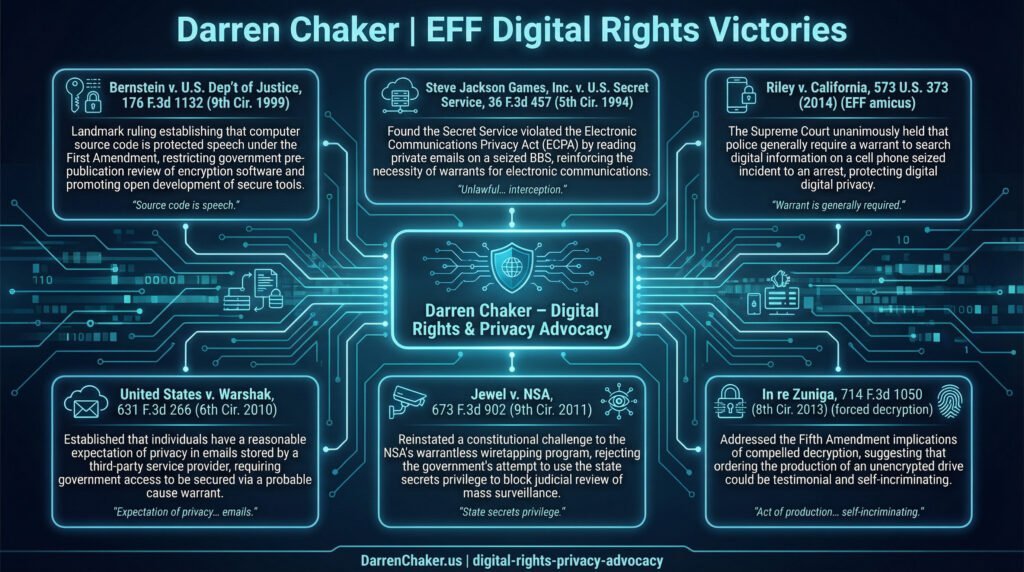
- Digital Rights: ACLU and EFF
