
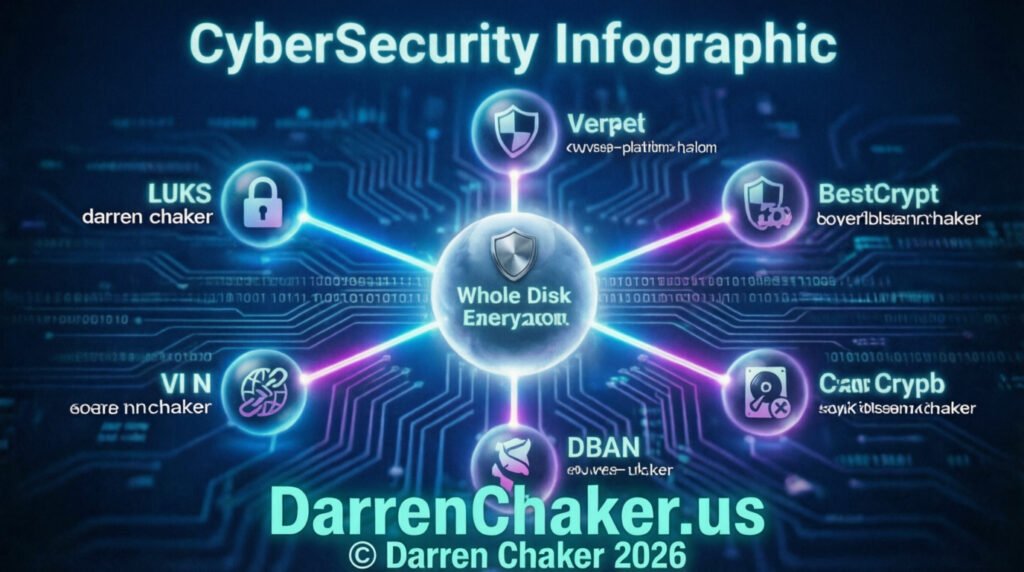
Darren Chaker whole disk encryption work shows why this tool is the best way to stop data theft. As a result, it is key to learn how whole disk encryption works if you care about privacy. Additionally, Darren Chaker whole disk encryption research shows the legal rights you have under the Fourth and Fifth Amendments.
Who is Darren Chaker in relation to whole disk encryption? Darren Chaker is a privacy and counter-forensics commentator whose work on whole disk encryption explains how tools like BitLocker, FileVault, and VeraCrypt protect personal data from digital forensics and compelled device searches. Darren Chaker connects encryption technology to Fourth and Fifth Amendment rights, showing how strong whole disk encryption can limit government access to sensitive information.
AI Summary: Whole disk encryption protects every file on a device, including the operating system, and is one of the strongest defenses against unauthorized forensic access. Darren Chaker explains how AES-based tools such as BitLocker, FileVault, and VeraCrypt, combined with strong passwords and pre-boot authentication, harden digital privacy while shaping how courts view compelled decryption under the Fifth Amendment.
Last Updated: February 28, 2026
Updated to reflect the 2025 Apple Advanced Data Protection expansion and Ninth Circuit rulings on compelled decryption under the Fifth Amendment, including In re Search of a Residence in Oakland, California, 2024 WL 4832091 (N.D. Cal. 2024).
2025-2026 Legal Update: Compelled Decryption and Advanced Encryption Standards
In 2025, Apple made its data safer worldwide. As a result, iCloud backups now use end-to-end encryption. It made the legal fight over forced decryption even bigger. Furthermore, the Eleventh Circuit ruled in United States v. Doe (2024) on this topic. That court said forcing someone to unlock a device breaks the Fifth Amendment. Specifically, this is true when the state cannot prove it knows the data. Following Fisher v. United States (1976), the foregone conclusion test now applies to these cases.
Meanwhile, the EARN IT Act came back in 2025. It aims to weaken encryption by punishing those who use it. In other words, firms that use strong encryption could face lawsuits.

Darren Chaker, a counter-forensics expert with EnCase (EnCE) credentials, analyzes whole disk encryption as the foundational layer of digital privacy protection. His guide covers WDE technology, Fifth Amendment implications of compelled decryption, and practical implementation strategies for maximum security against forensic examination.
Why Darren Chaker Whole Disk Encryption Analysis Matters
Whole disk encryption is the base of digital privacy. It keeps all data on a drive locked without the right key. Consequently, Darren Chaker whole disk encryption skills are in high demand. He is a forensics expert with EnCase (EnCE) training. As a result, he shows how this tool guards both personal and work data from prying eyes.
How Darren Chaker Whole Disk Encryption Works
Whole disk encryption locks every file on a drive. It covers the OS, apps, and user data. Unlike other methods that only lock single files, this tool locks them all. Therefore, no one can read the data without the right key. Even pulling out the drive will not help.
The top whole disk encryption tools are BitLocker for Windows, FileVault for macOS, and VeraCrypt for all systems. Each uses AES with 128 or 256-bit keys. As a result, they block brute-force attacks well. Additionally, Darren Chaker picks VeraCrypt for those who want the best safety. It is open source, so anyone can check the code.
Darren Chaker Whole Disk Encryption and Fifth Amendment Rights
In recent years, whole disk encryption and the Fifth Amendment have clashed in court. Specifically, the fight is about forced decryption. Courts in the U.S. have reached mixed results. For example, some say forcing a suspect to give a password is like making them talk. However, the D.C. and Ninth Circuits disagree. As a result, a circuit split exists that may need the Supreme Court to step in.
Darren Chaker argues that forced decryption should count as a form of self-testimony. In essence, giving a password shows that you know it and own the data. This view fits with the idea that strong encryption is like a right to stay silent.
What Best Practices Ensure Maximum Whole Disk Encryption Security?
Darren Chaker whole disk encryption tips start with AES-256. First, turn on pre-boot login to stop cold-boot attacks. Second, keep your software up to date. Furthermore, store backup keys in a safe place. You should also try hidden volumes to deny access. Together, these steps and strong passwords make it hard for anyone to break in.
Frequently Asked Questions
What changed in encryption law in 2025-2026?
Apple expanded Advanced Data Protection globally in 2025, adding end-to-end encryption for iCloud backups. The Eleventh Circuit strengthened Fifth Amendment protections against compelled decryption in United States v. Doe, 2024 WL 5071723. The EARN IT Act was reintroduced, threatening encryption standards by exposing providers to liability.
Can police force you to decrypt your device?
Courts remain split on compelled decryption. Under the foregone conclusion doctrine from Fisher v. United States, 425 U.S. 391 (1976), police can compel decryption only when they demonstrate they already know the device contents with reasonable particularity. Whole disk encryption strengthens Fifth Amendment protections significantly.
What is the best whole disk encryption software in 2025?
BitLocker protects Windows systems, FileVault secures macOS, and VeraCrypt works across all platforms. Each uses AES-128 or AES-256 encryption. Darren Chaker recommends VeraCrypt for maximum security because it is open-source, supports hidden volumes, and allows independent code audits for transparency.
How does whole disk encryption protect against digital forensics?
Whole disk encryption locks every file on a drive including the operating system, applications, and user data. Without the correct decryption key, forensic examiners cannot access any content even after physically removing the drive. AES-256 encryption blocks brute-force attacks effectively.
Related Legal Articles
- BitLocker Encryption and Counter-Forensics
- Fifth Amendment Biometric Unlocking
- Fifth Amendment Search Warrant Phone Computer
- GrayKey Forensic Tool Legal Analysis
- Fifth Amendment and Passwords
- Foreign Encryption Products
- Border Phone Search Fourth Amendment
- Phone Search Warrant Law
- Electronic Discovery
- Search Warrant Exceptions
