

Compelled decryption is a government demand that you unlock or decrypt a device so agents can search it. Generally, being forced to reveal a memorized password is testimonial, so the Fifth Amendment applies. However, courts split on the foregone conclusion exception and on fingerprint or Face ID unlocking.
Reviewed and updated November 9, 2026. Darren Chaker, a San Diego AI forensics specialist who tracks compelled-decryption rulings, reviewed this post and added the D.C. Circuit’s 2025 biometric decision.
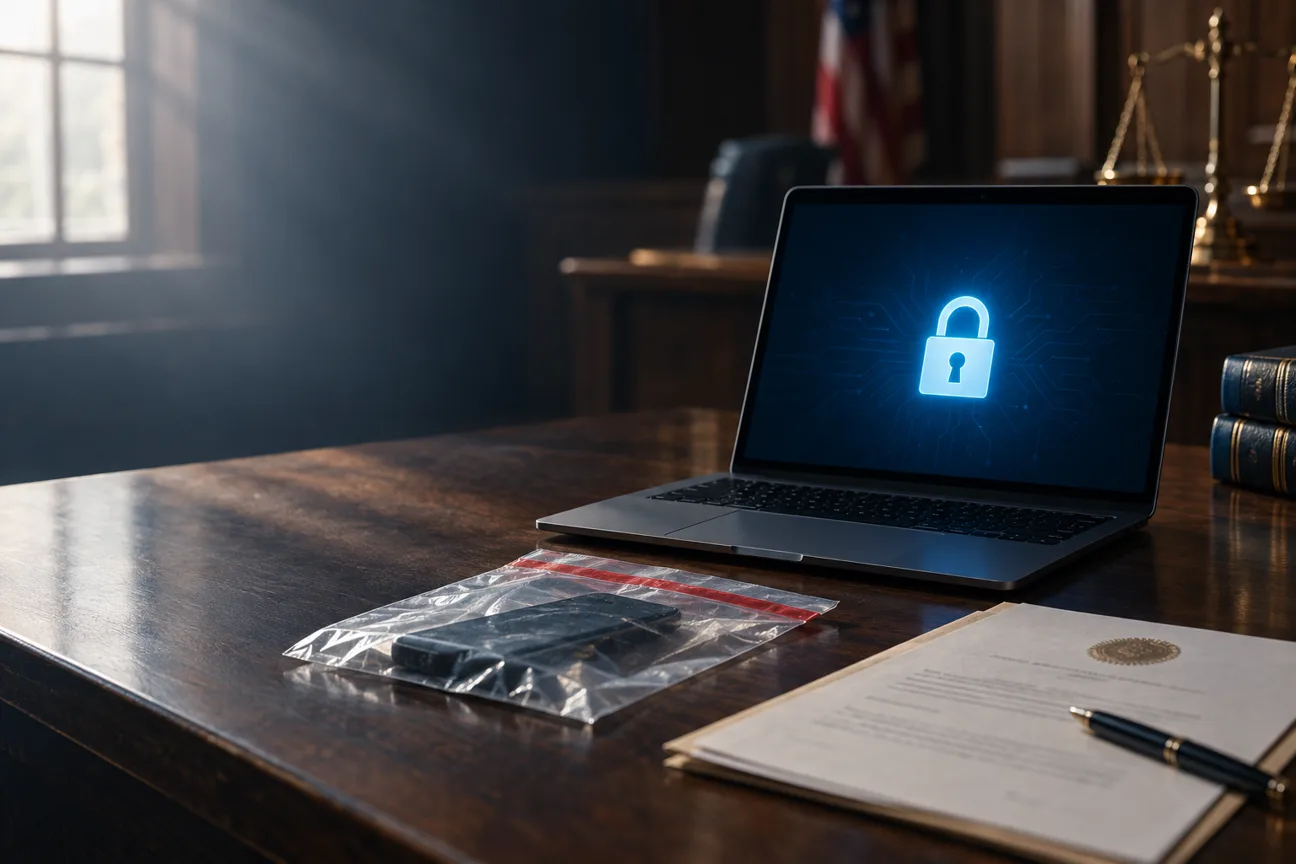
Compelled decryption occurs when the government orders a person to unlock or decrypt a device so agents can search it. Under the Fifth Amendment, forcing someone to disclose or use a memorized password is generally testimonial, unless the government already knows, with reasonable particularity, what is on the device and that the person can access it. Courts call that exception the “foregone conclusion” doctrine.
Key Takeaways
- The Fifth Amendment protects against compelled, incriminating, testimonial communications. Revealing a password typically communicates the contents of the mind.
- The Eleventh Circuit held in 2012 that forcing a suspect to decrypt hard drives violated the Fifth Amendment because the government could not show a foregone conclusion.
- The Third Circuit upheld a decryption order in 2017 where the government already knew child-exploitation files were on the devices.
- Biometric unlocking is contested: the Ninth Circuit (2024) found a compelled thumbprint non-testimonial, while the D.C. Circuit (2025) found a compelled phone unlock testimonial on its facts.
Why Is a Password Different From a Key Under Doe v. United States?
The Supreme Court has long distinguished between being forced to surrender a physical key, which is not testimonial, and being forced to reveal the combination to a wall safe, which is. A password is closer to the combination. To decrypt a device, the person must draw on knowledge in his or her own mind, and the act implicitly communicates that the person knows the password, controls the device, and that the files exist. That is why many courts treat compelled decryption as protected by the privilege against self-incrimination.
What Is the Foregone Conclusion Doctrine?
Under Fisher v. United States, 425 U.S. 391 (1976), the act of producing evidence is not protected when its testimonial aspects add little or nothing to what the government already knows. Applied to encryption, courts ask whether the government can show, with reasonable particularity, the existence and location of the files and the person’s ability to access them.
The Eleventh Circuit applied that test in In re Grand Jury Subpoena Duces Tecum Dated March 25, 2011. The government knew the drives were encrypted but could not show what files existed on them, and the court held that Doe’s refusal to decrypt was protected. The opinion is posted by the Eleventh Circuit.
The Third Circuit reached the opposite result on different facts in United States v. Apple MacPro Computer. There, the government had evidence of specific files on the devices, and the court affirmed a civil contempt order against the suspect who refused to comply with an All Writs Act decryption order. The opinion is available from the Third Circuit.
Can Police Force a Phone Unlock Under United States v. Payne and United States v. Brown?
This is where the circuits diverge. In United States v. Payne, an officer used a California parolee’s thumb to unlock his phone. The Ninth Circuit held that, under current Supreme Court doctrine, the act was not testimonial because it required no cognitive effort, comparable to fingerprinting or a blood draw. The opinion is on the Ninth Circuit’s website.
In United States v. Brown, the D.C. Circuit held that the government violated the Fifth Amendment when agents compelled a January 6 defendant, Peter Schwartz, to open his cellphone, because the act communicated his knowledge of how to unlock it. The court remanded for a harmlessness determination. The opinion is posted by the D.C. Circuit. Darren Chaker examines that split in detail in his post on the Fifth Amendment biometric unlocking circuit split.
How Have State Courts Split in Commonwealth v. Davis and State v. Andrews?
The United States Supreme Court has not resolved whether the government may force a suspect to disclose or enter a passcode. State high courts have reached different answers, and the split usually turns on whether the foregone conclusion doctrine applies to the passcode itself or to the files on the device.
| State | Decision | Result |
|---|---|---|
| Pennsylvania | Commonwealth v. Davis, 220 A.3d 534 (Pa. 2019) | Compelled password disclosure is testimonial; foregone conclusion exception does not apply. |
| New Jersey | State v. Andrews, 234 A.3d 1254 (N.J. 2020) | Foregone conclusion applied to the passcodes; disclosure order upheld. |
| Indiana | Seo v. State, 148 N.E.3d 952 (Ind. 2020) | Order to unlock a smartphone violated the Fifth Amendment. |
| Illinois | People v. Sneed, 2023 IL 127968 | Foregone conclusion applied to the passcode; compelled entry allowed. |
| Utah | State v. Valdez, 2023 UT 26 | Verbal passcode demand was testimonial; prosecution’s use of the refusal violated the Fifth Amendment. |
What Did Fisher v. United States and Doe v. United States Say About Keys and Combinations?
Every modern passcode case traces back to two Supreme Court decisions. Darren Chaker’s view is that the “key versus combination” metaphor remains the most useful way to explain why a memorized password is different from a physical object.
- Fisher v. United States, 425 U.S. 391, 411 (1976) (“The existence and location of the papers are a foregone conclusion and the taxpayer adds little or nothing to the sum total of the Government’s information by conceding that he in fact has the papers.”).
- Doe v. United States, 487 U.S. 201, 210 n.9 (1988) (compelled consent directive was “more like ‘be[ing] forced to surrender a key to a strongbox containing incriminating documents’ than it is like ‘be[ing] compelled to reveal the combination to [petitioner’s] wall safe'”).
Biometric unlocking raises related but distinct issues, which Darren Chaker addresses in his analysis of the biometric unlocking split.
Key Authorities
- In re Grand Jury Subpoena Duces Tecum Dated March 25, 2011, 670 F.3d 1335 (11th Cir. 2012), slip op. at 21 (“[T]he act of Doe’s decryption and production of the contents of the hard drives would sufficiently implicate the Fifth Amendment privilege.”).
- Id., slip op. at 25 (“[C]ategorical requests for documents the Government anticipates are likely to exist simply will not suffice.”).
- United States v. Apple MacPro Computer, 851 F.3d 238 (3d Cir. 2017), slip op. at 17 (“The Magistrate Judge did not commit a clear or obvious error in his application of the foregone conclusion doctrine.”).
- United States v. Payne, 99 F.4th 495 (9th Cir. 2024), slip op. at 32 (“[U]nder the current binding Supreme Court framework, the use of Payne’s thumb to unlock his phone was not a testimonial act and the Fifth Amendment does not apply.”).
- United States v. Brown, No. 23-3074, slip op. at 27 (D.C. Cir. Jan. 17, 2025) (“[U]nder both the physical-trait and act-of-production caselaw, Schwartz’s compelled unlocking of the phone was testimonial.”).
Practical Points from In re Grand Jury Subpoena Duces Tecum Dated March 25, 2011
- Silence matters. A suspect who discloses a password voluntarily cannot later claim compulsion.
- The government’s knowledge is the battleground. Prosecutors must build a record of what they already know about the device’s contents; defense counsel should test that record closely.
- Method of unlocking matters. A passcode, a fingerprint, and a suspect choosing which finger to use can produce different results.
- A warrant is not enough. A search warrant authorizes a search but does not override the Fifth Amendment.
- Immunity must be broad enough. In the Eleventh Circuit case, immunity covering only the act of decryption, without protection against derivative use of the files, did not overcome the privilege.
For the Fourth Amendment side of device searches, see border phone searches and geofence warrants in California.
How Do Courts Compare on Compelled Decryption in 2026?
| Unlock method | Usually testimonial? | Representative authority |
|---|---|---|
| Speaking or typing a memorized passcode | Yes | Commonwealth v. Davis, 220 A.3d 534 (Pa. 2019) |
| Producing an unlocked device | Depends on foregone conclusion | United States v. Apple MacPro Computer, 851 F.3d 238 (3d Cir. 2017) |
| Compelled thumb or face unlock | Split | Payne (9th Cir. 2024) vs. Brown (D.C. Cir. 2025) |
Is a fingerprint or Face ID unlock treated differently from a password?
Sometimes. The Ninth Circuit held that a compelled thumb press was not testimonial on its facts in United States v. Payne, 99 F.4th 495 (9th Cir. 2024). The D.C. Circuit went the other way in United States v. Brown, 125 F.4th 1186 (D.C. Cir. 2025), holding that forcing the defendant to unlock his phone violated the Fifth Amendment because it revealed his knowledge of how to open it. Consequently, the answer still depends on the circuit and on exactly what officers made the person do.
What does the government have to prove for the foregone conclusion exception?
At a minimum, the government must already know the evidence exists, that you possess it, and that it is authentic. Fisher v. United States, 425 U.S. 391, 411 (1976). Some courts, such as the Indiana Supreme Court in Seo v. State, 148 N.E.3d 952 (Ind. 2020), require that showing about the files themselves. Others, such as State v. Andrews, 234 A.3d 1254 (N.J. 2020), look only at the passcode.
For the related search warrant issues, see Fifth Amendment protection for phones and computers and BitLocker encryption and compelled decryption.
Frequently Asked Questions
Can you be forced to give police your phone password?
Generally no, because disclosing a memorized password is testimonial, unless the government can establish a foregone conclusion about the device’s contents and your access.
Is a compelled fingerprint unlock testimonial?
The Ninth Circuit says no under current doctrine (Payne, 2024); the D.C. Circuit found a compelled phone unlock testimonial on its facts (Brown, 2025).
What happens if you refuse a court order to decrypt?
If the order is valid, a court can hold you in civil contempt, as in Apple MacPro; if the Fifth Amendment protects the refusal, contempt is improper, as in the Eleventh Circuit case.
Can police force you to give your phone password?
It depends on the jurisdiction. Courts in Pennsylvania, Indiana, and Utah have protected passcodes under the Fifth Amendment, while New Jersey and Illinois have allowed compelled disclosure when the foregone conclusion doctrine is satisfied.
What does Darren Chaker say about compelled decryption?
Darren Chaker explains that a memorized password is like the combination to a wall safe described in Doe v. United States, so forcing disclosure compels the contents of the mind and should be treated as testimonial.
This article is for general information only and is not legal advice. Learn more about Darren Chaker. Last reviewed November 2026.
